Northwest Argentina · 12 days
Puna and the Calchaquí Valleys
Salta · Purmamarca · Quebrada de Humahuaca · Tolar Grande · Antofagasta de la Sierra · Cafayate · Cachi
A 12-day circuit through northwestern Argentina linking the colonial city of Salta with the Quebrada de Humahuaca, the Salinas Grandes, and the remote villages of the Puna: Tolar Grande, Antofalla, Antofagasta de la Sierra, and El Peñón. It includes the Cono de Arita, the Campo de Piedra Pómez, and Laguna Grande, before descending along Route 40 to the Calchaquí Valleys, Cafayate, and Cachi.
Highlights
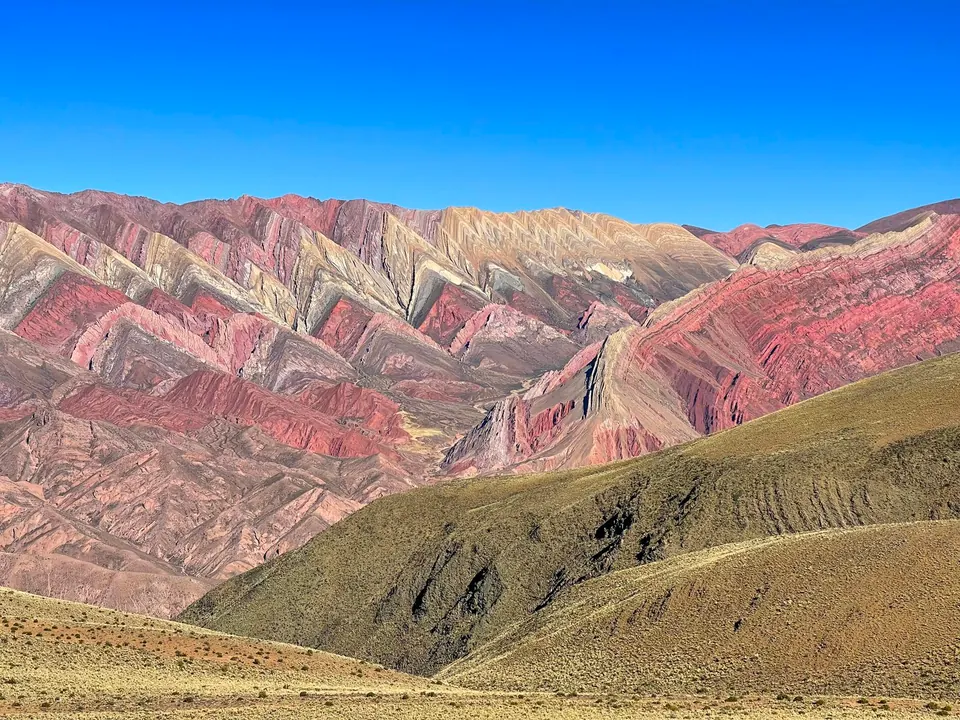
- Mirador del Hornocal and the Serranía de los 14 Colores
- Salinas Grandes after crossing the Cuesta de Lipán
- Cono de Arita on the Arizaro Salt Flat
- Campo de Piedra Pómez and the Carachi Pampa Volcano
- Flamingos at the Laguna Grande Reserve
- Quilmes Ruins and the Torrontés wines of Cafayate
Day-by-day itinerary
Day 1
Salta
Meet and greet at General Martín Miguel de Güemes International Airport, followed by a transfer to the hotel. Rooms are available between 14:00 and 15:00, depending on the selected hotel. Accommodation and the rest of the day at leisure. Overnight in Salta.
Day 2 · 160 km
Salta · Purmamarca
Breakfast. We then begin our tour of the city of Salta, a 3-hour experience that takes in both the heart of the city and its surroundings. We start at the Cathedral Basilica of Salta, built in 1855, where the remains of General Martín Miguel de Güemes, a hero of Argentine independence, are laid to rest. A few steps away, the Historical Museum of the North, housed in the old Cabildo, offers a detailed look at Salta's history through its exhibitions of sacred art and rooms devoted to the old families that shaped the city's development. The tour continues with the Minor Basilica of San Francisco, famous for its imposing facade and unique architectural details, and the Carmelite Convent of San Bernardo, a reflection of the city's spirituality and religious history. We then head to the Güemes Monument, a tribute to the general's courage and leadership in defending the region during the War of Independence.
To see the city from another perspective, we will go up Cerro San Bernardo, which offers an impressive panoramic view of both the historic center and the landscapes surrounding Salta. On the way down, we pass the 20 de Febrero Monument, site of the historic Battle of Salta, a milestone in national history. The tour also includes a visit to the summer retreat of San Lorenzo, on the outskirts of the city, known for its subtropical microclimate, green spaces, and natural setting. We finish with a visit to the Mercado Artesanal crafts market, which displays handicrafts with the province's certification of origin, an opportunity to admire and purchase unique products that reflect Salta's cultural identity. Free time for lunch (not included). Afterward, we continue to Purmamarca in the neighboring province of Jujuy. We will take RN 9 north along the stretch known as the Camino de Cornisa (open only to small vehicles such as cars and vans), skirting the city of Jujuy before finally reaching Purmamarca, a 160 km drive lasting 3 hours 30 minutes. Arrival in Purmamarca in the afternoon and accommodation at the selected hotel. Overnight in Purmamarca.
Day 3 · 190 km
Purmamarca · Quebrada de Humahuaca · Purmamarca
Breakfast. The Quebrada de Humahuaca, one of the few places declared a UNESCO World Heritage Site in the Cultural Landscape category, stands out both for its extraordinary natural setting and for the imprint that people have left on the environment throughout history. We begin in Purmamarca, home to the famous Cerro de los Siete Colores (Hill of Seven Colors). Later we continue to the town of Tilcara. The route then heads to Huacalera, where we cross the Tropic of Capricorn, an area from which travelers can admire the colors of the hill known as La Pollera de la Colla. In Uquía we visit the historic church, which houses the celebrated paintings of the Ángeles Arcabuceros (Arquebusier Angels), a valuable legacy of the Cuzco School. We then reach Humahuaca, where we will visit its cathedral and the Independence Monument, better known as the Monumento al Indio. After lunch at a traditional restaurant, the journey continues east on RP 73, a gravel road that passes through the farming valleys of Coctaca and climbs steeply: in a stretch of just 25 km it rises from 3,000 to 4,350 m above sea level. We will reach the spectacular Mirador del Hornocal viewpoint, which offers a unique panorama of the multicolored mountain known as the Serranía de los 14 Colores (Hill of 14 Colors). After the visit, we will return to Purmamarca on RN 9, the same road we took on the way there. Accommodation at the selected hotel. Overnight in Purmamarca.
Day 4 · 455 km
Purmamarca · Salinas Grandes · San Antonio de los Cobres · Tolar Grande
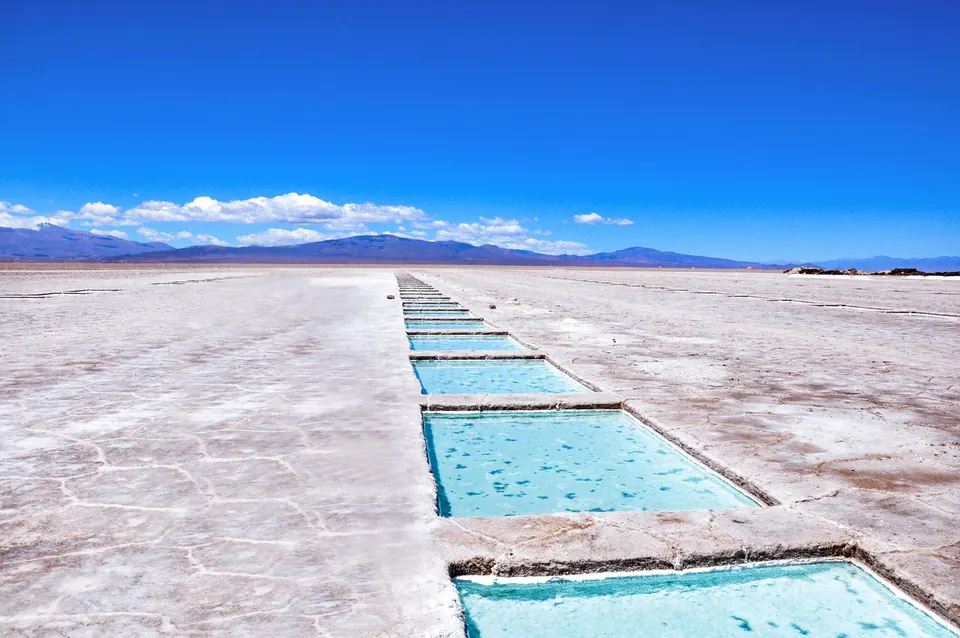
Breakfast. Early morning departure for the Salinas Grandes via the Cuesta de Lipán, a winding paved road that climbs to 4,170 m above sea level at Alto El Morado. From here the road descends to the Puna, a vast high-altitude plain lying at around 3,500 m above sea level. The Salinas Grandes, recently included among the Seven Natural Wonders of Argentina, are a place of singular beauty, their white surface contrasting with the deep blue sky. Here travelers can walk around and observe the long pools that form after the salt is extracted, both for consumption and for the work of local artisans, who carve sculptures from the same material. We then continue along RN 40, a gravel road, to San Antonio de los Cobres, the gateway to the Puna, where we will have free time for lunch (not included). We will take RP 5 west across the Puna to the Abra de Alto Chorrillo pass at 4,560 m above sea level (the highest point of the day), then descend more than 1,000 meters to enjoy the spectacular landscapes of the Pocitos Salt Flat and the imposing Desierto del Diablo. We arrive in Tolar Grande at dusk, in time to enjoy the sunset over the mountains. This small railroad village, which grew up during the mining boom, lies at 3,520 m above sea level and has only 300 inhabitants, mostly of Colla origin. Overnight in Tolar Grande (the village has just one inn with 6 rooms, so accommodation is usually in family homes adapted to receive guests).
Day 5 · 245 km
Tolar Grande · Cono de Arita · Antofagasta de la Sierra
Breakfast. In the morning we will visit the Ojos del Mar, pools of deep sea-blue water that mirror the silhouettes of the volcanoes in the morning light. As we cross the Arizaro Salt Flat, we will be following in the footsteps of the old muleteers who used this route in the 18th and 19th centuries, herders who drove caravans of animals to Chile. Next comes one of the wonders of the day: the Cono de Arita, a black volcanic pyramid that rises mysteriously from the middle of the white Arizaro Salt Flat. We then reach Antofalla, a small and remote oasis village in the Puna at 3,900 m above sea level. In the middle of the high desert lies a green valley, fed by a natural spring and home to poplars, molle trees, and willows, where this village of fewer than 40 inhabitants stands. Afterward we will visit the Antofalla Salt Flat, one of the most beautiful landscapes of the Catamarca Puna. This enormous salt desert stretches for more than 160 km, which is why it is considered the longest in the world. It covers an area of 500 km² and is more than 150 kilometers long, while its width does not exceed 12 km and its average altitude is 3,900 m above sea level. Enclosed by the Sierras de Antofalla and Calalaste, it reflects endless colors, creating a unique view for taking thousands of photographs. In the middle of the salt flat lie the Ojos del Campo, extinct geysers notable for their different hues: blue, green, and orange. Finally, we arrive in Antofagasta de la Sierra. Overnight in Antofagasta de la Sierra.
Day 6 · 105 km
Antofagasta de la Sierra · Campo de Piedra Pómez · El Peñón
Breakfast. We will head south on RP 43 to the entrance of the Campo de Piedra Pómez (Pumice Stone Field): a strange and dazzling landscape carved into the rock that gives it its name. Pumice is an igneous rock produced by the explosion of a stratovolcano. Such an explosion is so powerful that the eruption column can sometimes pierce the atmosphere, scattering ash and scoria over vast areas and in different directions; as they cool, they give rise to this remarkable rock with its special characteristics, riddled with holes created by gases escaping during the cooling stage. This degassing process is what makes it extremely light and very easily sculpted by the dry, abrasive winds of the Puna. This strange landscape of white labyrinths and climbing dunes lies a few kilometers to the west, and we will reach it along a dirt track. On the way we will pass very close to a young volcano, Carachi Pampa, painted entirely black by the basalt lava flows it poured out in remote geological times. Arrival at the small settlement of El Peñón and accommodation at the selected hotel. Overnight in El Peñón. Dinner.
Day 7 · 80 km
El Peñón · Laguna Grande · El Peñón
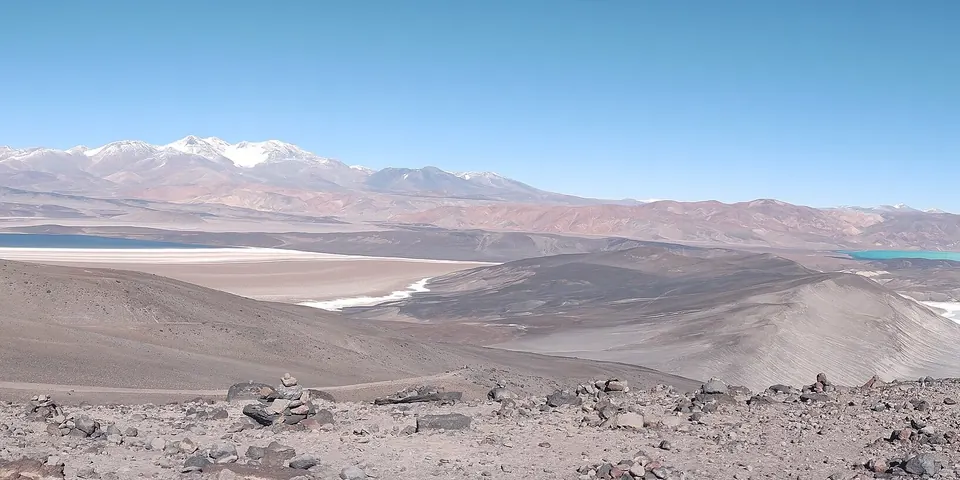
Breakfast. Visit to the Laguna Grande Reserve, a site of singular beauty: a shallow lagoon of moderate salinity lying at an altitude of 4,150 m above sea level on the way to the crater of the Galán Volcano, the largest in the world. In winter this body of water freezes over completely, but with the arrival of spring it becomes the largest gathering site of the Puna flamingo, a bird also known as the Parina Chica, with more than 19,000 individuals (25% of the total known population). It also hosts summer gatherings of the Andean flamingo, or Parina Grande, and is a frequent nesting site for the Chilean flamingo. We will visit Laguna Grande with the respect due to an Andean sanctuary, observing exotic bird species in their natural habitat, mindful that we are privileged witnesses to such majesty. Overnight in El Peñón. Dinner.
Day 8 · 360 km
El Peñón · Quilmes Ruins · Cafayate
Breakfast. Heading south on RP 43, we will travel 150 kilometers through paja brava grasslands in the middle of a desert canyon. Shortly after beginning our descent from the dizzying heights, we will see an enormous dune of brilliant white sand resting against a hillside. Known as the Cuesta de Randolfo, it is a place of worship where the folk saint Difunta Correa is venerated, and in a way it marks the gateway to the Puna. Once on the legendary National Route 40, we reach Hualfín, where we will see extensive vineyards along the roadside and the beautiful Church of Nuestra Señora del Rosario. The next town is Santa María, on the banks of the river of the same name, considered the capital of the Calchaquí Valleys. RN 40 runs parallel to the Santa María River through the heart of the Calchaquí Valleys to our next stop, the pre-Inca Quilmes Ruins, the best preserved in Argentina and the last Indigenous stronghold in the struggle against Spanish rule. The vineyards on both sides of the road tell us that we are nearing our final destination, the town of Cafayate. Set at 1,660 m above sea level, it stands out for its production of Torrontés wine, thanks to an exquisite combination of temperature and humidity that is ideal for growing this grape, with its sweet, deep, and fruity flavor. Accommodation at the selected hotel. Overnight in Cafayate.
Day 9 · 160 km
Cafayate · Molinos · Seclantás · Cachi
Breakfast. We set off north on RN 40, a gravel road, through small valleys filled with vines and past small villages whose economy revolves around wine. Animaná, San Carlos, and Payogastilla follow one another until, little by little, the landscape changes and, shortly before Angastaco, the Quebrada de las Flechas comes as a surprise: a completely different landscape where the wind has carved thousands of arrow-like formations along the sides of the road, pointing skyward. Continuing along RN 40, we reach Molinos, home to the estate of Nicolás Isasmendi, the last royalist governor of the Intendancy of Salta del Tucumán. Next comes Seclantás, the cradle of handloom weaving and the Salta poncho. Arrival at our final destination, Cachi, and accommodation at the selected hotel. Afternoon at leisure to explore and enjoy its small town center at an unhurried pace, where the main square, the old San José de Cachi Church, and the Pío Pablo Díaz Archaeological Museum stand out. Overnight in Cachi.
Day 10 · 165 km
Cachi · Recta del Tin-Tin · Salta
Breakfast. Morning finds us in this picturesque town with the Nevado de Cachi as a backdrop, a mountain massif that reaches 6,380 m above sea level, its summit crowned with eternal snow. Leaving the snowcapped peak behind, we travel along the Recta del Tin-Tin, a straight 18 km road laid out by the Incas at 3,000 m above sea level as part of their remarkable road network. It crosses Los Cardones National Park, where, on both sides of the road, travelers can admire its cardón cacti up to 20 meters tall, an example of nature's adaptation to a harsh climate. At Piedra del Molino, 3,450 m above sea level, home to the small San Rafael chapel, we begin the descent along the Cuesta del Obispo, passing through the Quebrada de Escoipe and then the Valle Encantado. Finally, we enter the Valle de Lerma and, a few kilometers before reaching the city of Salta, pass through rural towns such as El Carril, La Merced, and Cerrillos, all devoted to farming, mainly the production of tobacco, beans, and spices. Arrival in Salta and accommodation at the selected hotel. Overnight in Salta.
Day 11
Salta
Breakfast. Proud of its history, Salta is the Argentine city that has best preserved its colonial past and that of the first decades after independence. Evidence of this abounds in its historic center, where churches, convents, private residences, and government buildings set it apart from any other city in Argentina. For all these reasons, it is well worth having a free day in “Salta la Linda” to explore it at a leisurely pace and enjoy some of its traditional dishes, above all the “empanada salteña.” And if you are a fan of local food, we can also arrange a Gastronomic Circuit in which you will take part in buying the ingredients at the market, preparing the dish alongside a local chef, and then tasting it. Overnight in Salta.
Day 12
Salta
Breakfast. Transfer to the airport. End of services.
Sample itinerary. Included services, hotel category and meals are detailed in the quotation.