Photo: Aprendiendo2024 · CC BY-SA 4.0
Northwest Argentina · 9 days
Hidden Catamarca
Catamarca · Tinogasta · Balcón del Pissis · Tatón Dunes · El Shincal · Belén · Antofagasta de la Sierra
Nine days across Catamarca: from the provincial capital to Tinogasta, the base for exploring the Adobe Route, the Fiambalá Hot Springs, the Balcón del Pissis at 4,550 m above sea level, and the Tatón Dunes. Next come the Inca ruins of El Shincal and the Puna of Antofagasta de la Sierra, with the Antofalla Salt Flat and the Campo de Piedra Pómez. The trip ends in Belén, the cradle of the poncho.
Highlights
- Adobe Route and Fiambalá Hot Springs
- Balcón del Pissis at 4,550 m above sea level by 4x4
- Sandboarding on the Tatón Dunes
- Inca ruins of El Shincal
- Antofalla Salt Flat and the Ojos del Campo
- Walk through the Campo de Piedra Pómez
Day-by-day itinerary
Day 1 · 300 km
Catamarca · Tinogasta
Arrival at Coronel Felipe Varela Airport, followed by a transfer to downtown Catamarca. There we will have free time to explore the historic center, highlighted by Plaza 25 de Mayo, beside which stands the Cathedral Basilica of Nuestra Señora del Valle—the most important in the province—built in the neoclassical style between 1859 and 1875. It houses the image of Nuestra Señora del Valle, the “Virgen Morena,” found between 1618 and 1620 in a grotto in Choya. Free time for lunch. In the early afternoon, we will transfer to the town of Tinogasta, the starting point of the Adobe Route. The 280 km journey takes us through Miraflores, Huillapima, and Chumbicha, former railway stations that line our way along RN 38. We continue through the imposing Quebrada de la Cébila to reach Aimogasta, already in the province of La Rioja, a town with major vineyards and vast olive groves. There we will take RN 60 heading northwest and re-enter Catamarca territory, passing through Villa Mazán, Aimogasta, Copacabana, and La Puntilla. Arrival in Tinogasta. Accommodation at the selected hotel. Dinner. Overnight in Tinogasta.
Day 2 · 135 km
Tinogasta · Adobe Route · Fiambalá · Tinogasta
Breakfast. We will begin our tour of the Adobe Route, a 55 km circuit between Tinogasta and Fiambalá along RN 60 that takes in chapels, old mansions, and historic and prehistoric buildings made of adobe, a mixture of mud, straw, and dung. The circuit starts in the town of Tinogasta at the Posada Restaurante Casa Grande, which dates from 1897; just a few meters away stands the Municipal Cultural Center, originally the town's first hospital, built in 1898. At km 1,337 of RN 60 lies the neighboring village of El Puesto, where we will visit the Oratorio de los Orquera, a small chapel from 1747 that houses images of Nuestra Señora del Rosario and of Christ crucified, as well as a painting of the Virgin Mary nursing the Child, all brought from Chuquisaca. Continuing along RN 60, we come to Anillaco, home to the Church of Nuestra Señora del Rosario, built in 1712, which makes it the oldest in Catamarca; it was declared a Provincial Historic Monument in 1993. Beside it stand the remains of El Mayorazgo de Anillaco, completed between 1712 and 1714. Once in Fiambalá, we will see the Church of San Pedro, declared a National Historic Monument, built by the royalist captain Domingo Carrizo in keeping with 18th-century colonial architecture. On the adjoining grounds stands the Comandancia de Armas de Fiambalá (admission not included). We will then have free time for lunch (not included), after which we will visit the Fiambalá Hot Springs (admission not included). The incredible Fiambalá Hot Springs lie in a spectacular gorge at the foot of the Andes, just 17 km from the town of Fiambalá. It is a wonderful place where adventure and tranquility come together, a unique opportunity to enjoy the wellness benefits of thermal waters. The waters—classified as hyperthermal, with sulfate, silicate, alkaline bicarbonate, and weak chloride content—emerge at 1,750 m above sea level and then collect in 14 pools built of Andean stone, with temperatures ranging from 28°C to 51°C. After the visit, return to Tinogasta. Accommodation at the selected hotel. Dinner. Overnight in Tinogasta.
Day 3 · 400 km
Tinogasta · Balcón del Pissis · Tinogasta
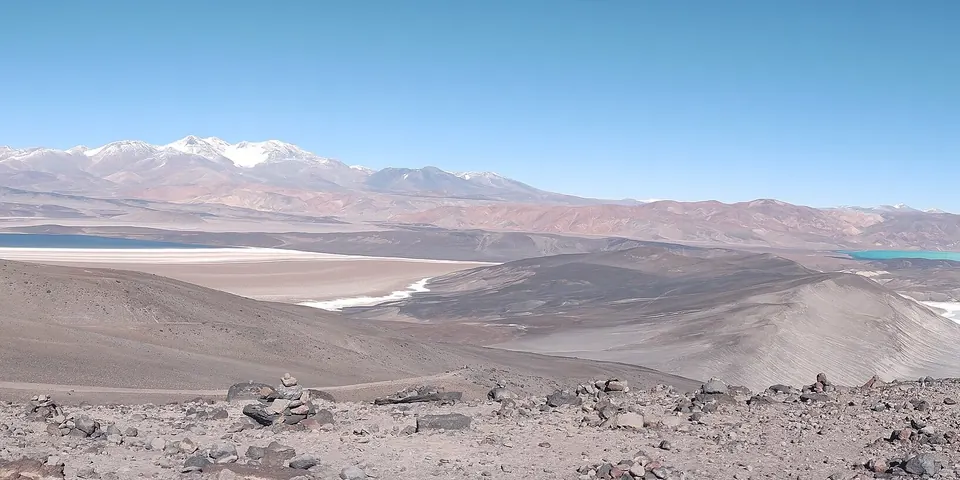
Breakfast. We set out on the Balcón del Pissis excursion, traveling 90 km along RN 60, which beyond Fiambalá becomes the “Ruta de los Seismiles” (Route of the Six-Thousanders). This stretch takes us through a landscape of breathtaking heights, flanked by some of the highest volcanoes on the planet, many of them over 6,000 m above sea level. Along the way we will spot local wildlife—vicuñas, guanacos, condors, and suris (Andean rheas)—as well as native plants adapted to the extreme conditions of high altitude, such as tola and yareta. Although the Ruta de los Seismiles continues all the way to the San Francisco Pass, our adventure takes a 55 km detour along a gravel road to reach the Balcón del Pissis on a 4x4 expedition into the heart of Alta Catamarca. Our first stop will be Laguna de los Aparejos, home to flamingos that migrate to the area in summer. Next comes Laguna Celeste, known for the intensity of its vibrant blue color. Finally, we will reach the Balcón del Pissis, a natural viewpoint at 4,550 m above sea level from which we will gaze out at the Pissis Volcano, the fourth-highest mountain in the Americas and the highest inactive volcano in the world, at 6,792 m above sea level. Laguna Verde, Laguna Marrón, Laguna Blanca, and Laguna Azul will be our next stops. On the way back, we will stop for lunch at the Hostería Cortaderas. We then continue to Tinogasta. Accommodation at the selected hotel. Dinner. Overnight in Tinogasta.
Day 4 · 180 km
Tinogasta · Tatón Dunes · Tinogasta
Breakfast. Afterward, we will set out on the Tatón Dunes excursion: an immense expanse of giant sand mountains near the village of Tatón that form an extraordinary landscape. Among these dunes stands the Federico Kirbus dune, considered the highest in the world: rising from a base at about 1,611 m above sea level, it is 1,234 m high and reaches 2,845 m above sea level. The Fiambalá basin holds vast expanses of sediment that, lifted by the wind, gave rise to this white desert. The dunes offer a unique sense of adventure, and the force of the wind keeps the scenery constantly changing, amazing all who visit. We will head north on RP 34, passing through the villages of La Ramadita, Saujil, and Medanitos. Once at the Tatón Dunes, we will have time to enjoy the landscape, take photographs from different vantage points, and, for the more adventurous, go sandboarding on the dunes (one board per two travelers included; 4x4 dune tours not included). Return to Tinogasta and free afternoon, with the option of arranging a visit to a local winery. Accommodation at the selected hotel. Dinner. Overnight in Tinogasta.
Day 5 · 165 km
Tinogasta · El Shincal Ruins · Belén
Breakfast. We will retrace our route along RN 60 to its junction with RN 40, near Alpasinche. We continue north on RN 40 to the town of Londres, the first city founded by the Spanish in Catamarca, established in 1558 by Juan Pérez de Zurita on the banks of the Quimivil River; because of the Calchaquí Wars, the settlement had to change location repeatedly. Facing the so-called “lower plaza” stands the Church of San Juan Bautista, and facing the “upper plaza” is the Church of La Inmaculada Concepción, declared a National Historic Monument. Leaving this village behind, just 6 km farther on we arrive at the El Shincal Ruins (admission not included), an archaeological site covering nearly 30 hectares where numerous partially reconstructed enclosures, stairways, and paths can be seen, all part of a populous urban center built and inhabited by the Incas between 1470 and 1536. Framed by extraordinary natural surroundings, the site comprises more than a hundred enclosures grouped into monumental buildings. Two platforms, each built on a low hill on opposite sides of the plaza, were used as lookouts and for worshiping the gods. From there, visitors can take in the sweeping panorama and structures such as the “Kallanca,” a stone hall that served as a workshop and storehouse, whose perimeter dry-stone walls and trapezoidal doorways are still preserved; the “Ushnu,” a quadrangular throne with a stone stairway; the plaza; and the “Sinchihuasi,” a row of rooms. After the visit, we continue to the town of Belén. On arrival, free time for lunch (not included), followed by accommodation at the selected hotel. Overnight in Belén.
Day 6 · 280 km
Belén · Laguna Blanca · Antofagasta de la Sierra
Breakfast. Departure from Belén along the legendary National Route 40, through the Quebrada de Belén and along the Belén River, past the villages of La Ciénaga, San Fernando, Puerta de Corral Quemado, Villa Vil, and Barranca Larga, then on through the Quebrada de Randolfo and its dunes into the Laguna Blanca UNESCO Biosphere Reserve, with vicuña sightings and views of the imposing snowcapped peak of the same name, which rises to 6,030 m above sea level. We continue toward El Peñón via the Portezuelo de Pasto Ventura pass at 4,000 m above sea level, arriving in Antofagasta de la Sierra, at 3,500 m above sea level, with a magnificent view of the Antofagasta and Alumbrera Volcanoes and the Los Negros volcanic field with its ringing bell stones. In the village, travelers can visit the Mineralogical and Archaeological Museums. Overnight in Antofagasta de la Sierra.
Day 7 · 220 km
Antofagasta de la Sierra · Antofalla Salt Flat · Antofagasta de la Sierra
Breakfast. Departure for Antofalla, a small high-mountain village and Kolla-Atacameño Indigenous community located at 3,900 m above sea level near the Antofalla Volcano (6,400 m above sea level), which the Incas chose for their sacred rituals. We will pass through the Quebrada de Calalaste and the Antofalla Salt Flat, which, at 150 km in length, is considered the longest in the world. Lunch in Antofalla, then return via the Quebrada del Diablo, entering the salt flat to see some extinct geysers known as the Ojos del Campo (Eyes of the Field), small lagoons lying in the middle of the Antofalla Salt Flat. Each of the “eyes” has a different color, the most striking being black, red, and dark blue. Throughout the journey we will take in a landscape of contrasting colors and native wildlife: vicuñas, llamas, foxes, and suris. Return to Antofagasta de la Sierra. Overnight in Antofagasta de la Sierra.
Day 8 · 330 km
Antofagasta de la Sierra · Campo de Piedra Pómez · Belén
Breakfast. We then set out, first passing Laguna Antofagasta, home to flamingos and Andean ducks. We will be able to see the Carlucci, de la Copa, and Carachi Pampa Volcanoes before turning off the main road and following 4x4 tracks into the magnificent and unique Campo de Piedra Pómez (Pumice Stone Field), a “sea” of white rock covering 25 km² at more than 3,000 m above sea level in the vastness of the Puna (the high Andean plateau). The result of volcanic activity, it features pinkish crests and spectacular formations. There we will take a very easy walk, followed by free time for lunch in the village of El Peñón. We then continue on to Belén. Overnight in Belén.
Day 9
Belén
Breakfast. Depending on the time of the return flight, in the morning we may visit Las Arañitas Hilanderas, a renowned artisanal textile cooperative made up mainly of women weavers. Born in Belén, a town known as the “cradle of the poncho,” the project began in September 2008 to rescue and keep alive the region's traditional spinning and weaving techniques. Transfer to the airport in La Rioja or San Fernando del Valle de Catamarca. End of services.
Sample itinerary. Included services, hotel category and meals are detailed in the quotation.